
- General AI models do not know a company's internal policies, procedures, contracts, manuals, or operational rules.
- Reliable answers require a system that selects relevant, authorized supporting content before the model responds.
- This companion platform demonstrates the architecture described in the book with a working search and chat environment.
Engineering AI Knowledge Systems
An AI knowledge system is not a chatbot. It is a controlled system that determines how information is created, ingested, structured, retrieved, and presented to a model at the moment a question is asked.
The failure is not in the model. The failure is in the system that decides what information the model is allowed to use. Organizations already have the knowledge required to answer most operational questions. The problem is not missing information — it is the inability to control, locate, and deliver the right information at the moment it is needed.
This book and companion system show how to convert company documentation into a retrieval-driven knowledge platform. The platform supports traditional indexed search, AI-assisted answers, document identity standards, metadata control, security filtering, and traceability back to source material.
The principle is direct: AI does not create knowledge. It retrieves and assembles it. If retrieval is not controlled, accuracy cannot be enforced.

- Get consistent, accurate answers based on your company's trusted knowledge and authorized business data.
- Ask natural-language questions about current business operations and receive explainable answers supported by real-time analytics.
- Generate executive dashboards, charts, and visualizations directly from authorized operational data.
- Combine operational analytics with company procedures, policies, manuals, and institutional knowledge to support better decisions.
- Reduce dependency on key employees for routine questions, operational knowledge, and business analysis.
- Ensure every answer is traceable through supporting evidence, generated SQL, retrieved data, and source documents.
- Control access to both knowledge and operational data using role-based security and governed permissions.
- Continuously improve organizational intelligence through controlled knowledge updates, explainable analytics, and ongoing performance measurement.
What this companion site is
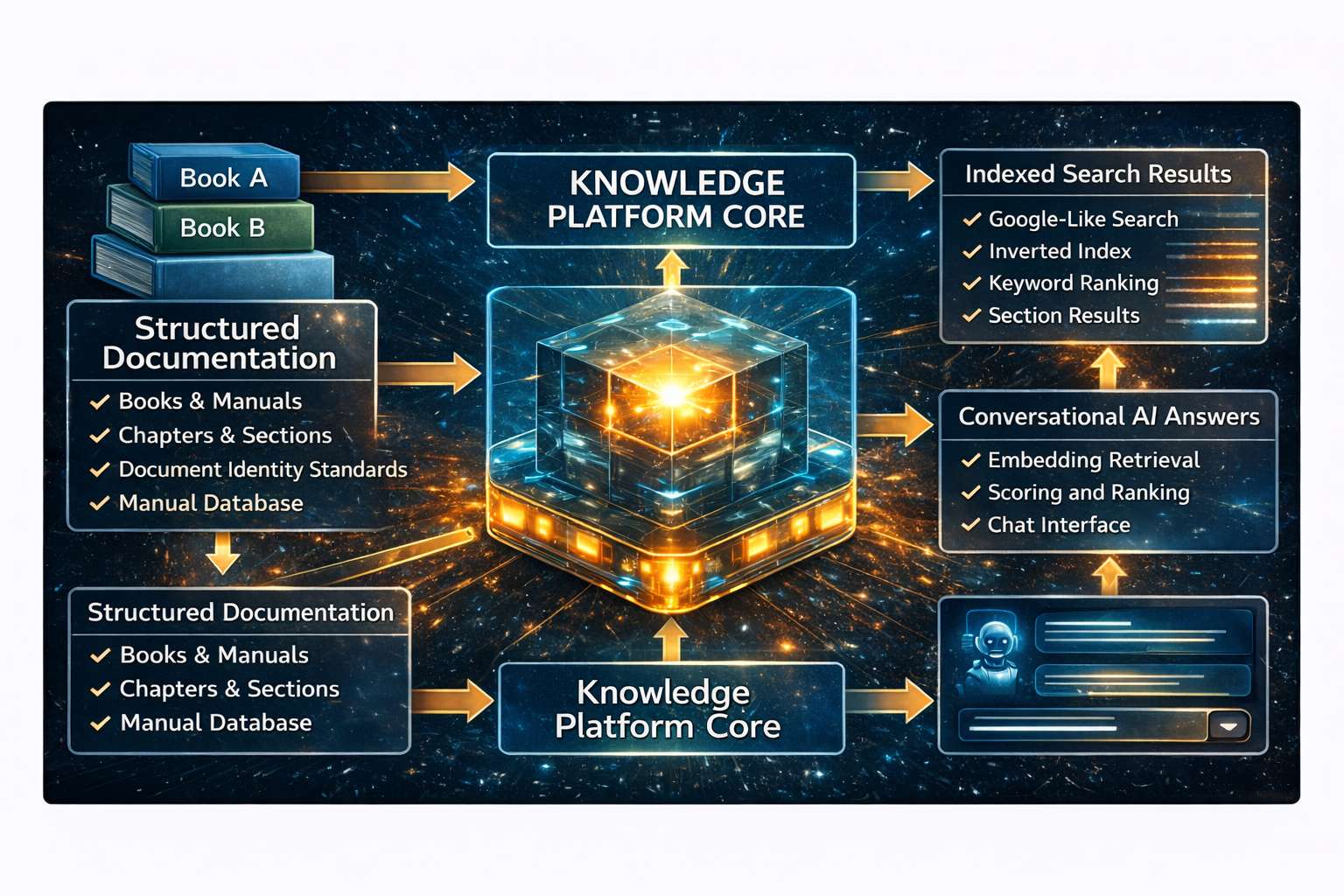
This is a working implementation of the system described in the book. It demonstrates how structured documentation, indexed search, ingestion, retrieval scoring, and chat interaction operate as one controlled knowledge platform.
Access the demo system
Demo registration creates read-only guest access. Guest users can view the platform and test the experience, but they cannot update, delete, ingest, or administer content.
Investment and Acquisition Opportunity
The methodology demonstrated by this book and companion system has evolved into a complete Corporate AI Knowledge Platform available for software acquisition, enterprise licensing, strategic partnership, or OEM commercialization.
The opportunity includes working software, live demonstration systems, technical architecture materials, operating documentation, training materials, published intellectual property, and executive investor presentations.
What the system demonstrates
- Structured book, chapter, section, screen, and procedure documentation.
- Google-style keyword retrieval using an inverted index.
- AI retrieval using chunks, embeddings, keywords, metadata, vector search, and security controls.
- Natural-language access to authorized real-time operational business data through governed, read-only database connections.
- Explainable analytics with generated SQL, executive visualizations, and complete processing transparency.
- Traceable answers that can be evaluated, reviewed, validated, and continuously improved over time.
Suggested search topics
These terms reflect real system capabilities without exposing proprietary scoring formulas or tuning logic.
Contact
Use the contact options for book questions, software interest, implementation discussions, or support.
About the author
Ivan Rodriguez is a technology executive, systems architect, and software developer with more than fifty years of experience in information technology. Beginning his career in 1973 as an entry-level programmer, he advanced through technical and management leadership roles to become Assistant Department Director within county government, overseeing large-scale mission-critical technology operations.
His experience spans software development, infrastructure, databases, telecommunications, strategic planning, procurement, operations, and enterprise modernization. That combination of hands-on technical depth and executive leadership informs the practical system approach presented in this book.
The problem this system solves
Most organizations begin AI implementation with a model. This platform begins with control. The system must determine what information is allowed to answer a question before a response is created.
AI models do not know your company’s policies, procedures, contracts, or operational rules. Without a controlled retrieval process, responses are incomplete, inconsistent, or incorrect because the model is not grounded in your actual business information.
This system solves that problem by selecting supporting material using keyword signals, synonym expansion, phonetic matching, metadata alignment, business domain context, and vector proximity.
The result is simple: the accuracy of AI answers depends on the system that controls what information is retrieved. Without that control, accuracy cannot be enforced.
Why this matters to your business
- Eliminate repeated questions and reduce dependency on key employees
- Ensure answers are based on approved, current company information
- Protect sensitive data through controlled retrieval and security filtering
- Reduce time spent searching for documents, procedures, and internal knowledge
- Build a system that scales as your organization grows without increasing support overhead
Instead of relying on individuals or disconnected documents, the organization gains a controlled system for delivering consistent, traceable, and reliable answers.
See the system in action
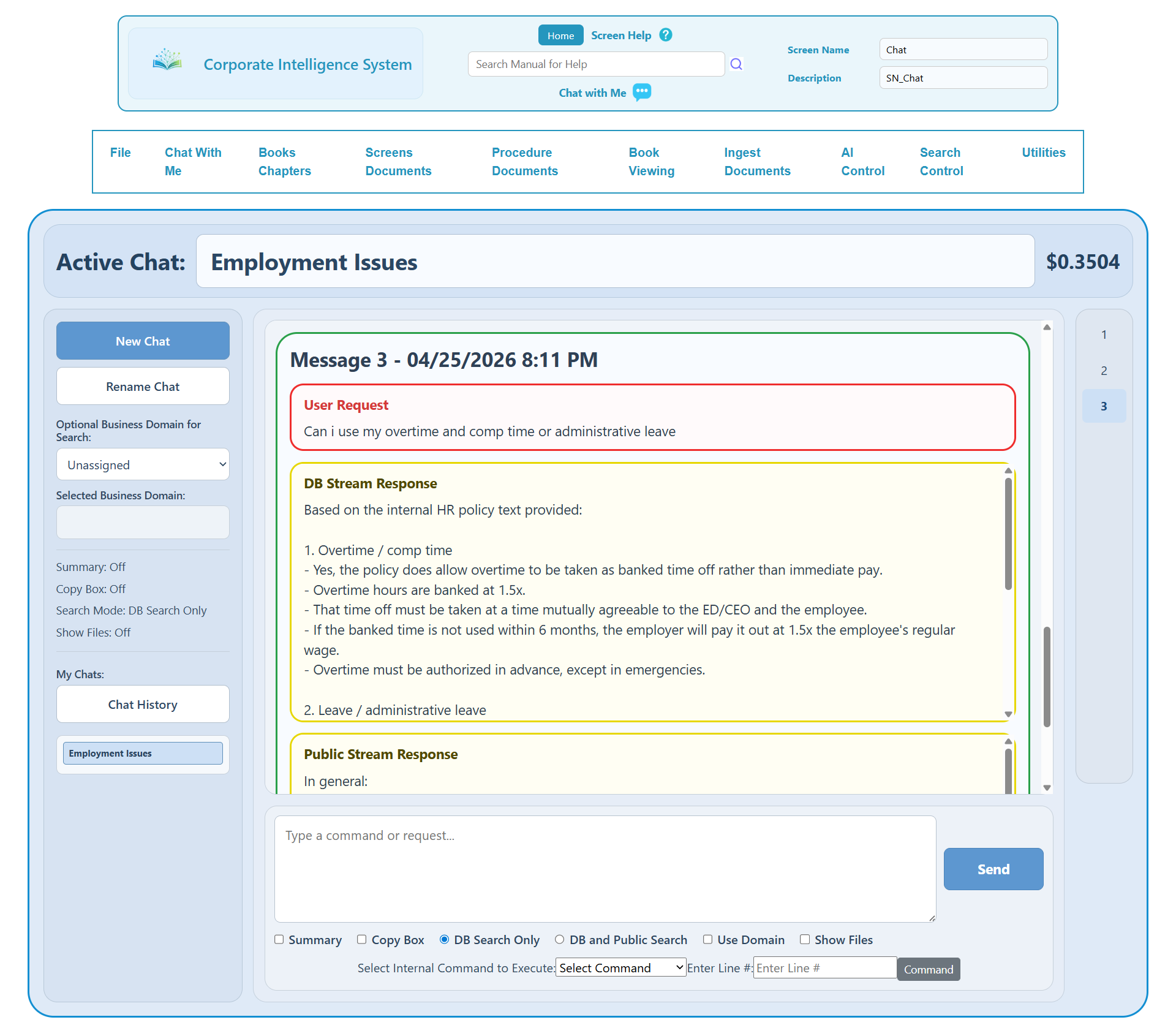
The chat interface is the proof point. It shows how real questions are answered using controlled, traceable internal information. It shows how a user question can be answered using selected internal support material, how the response can distinguish internal and public sources, and how the system can preserve history for review and improvement.
Enterprise Analytics Intelligence
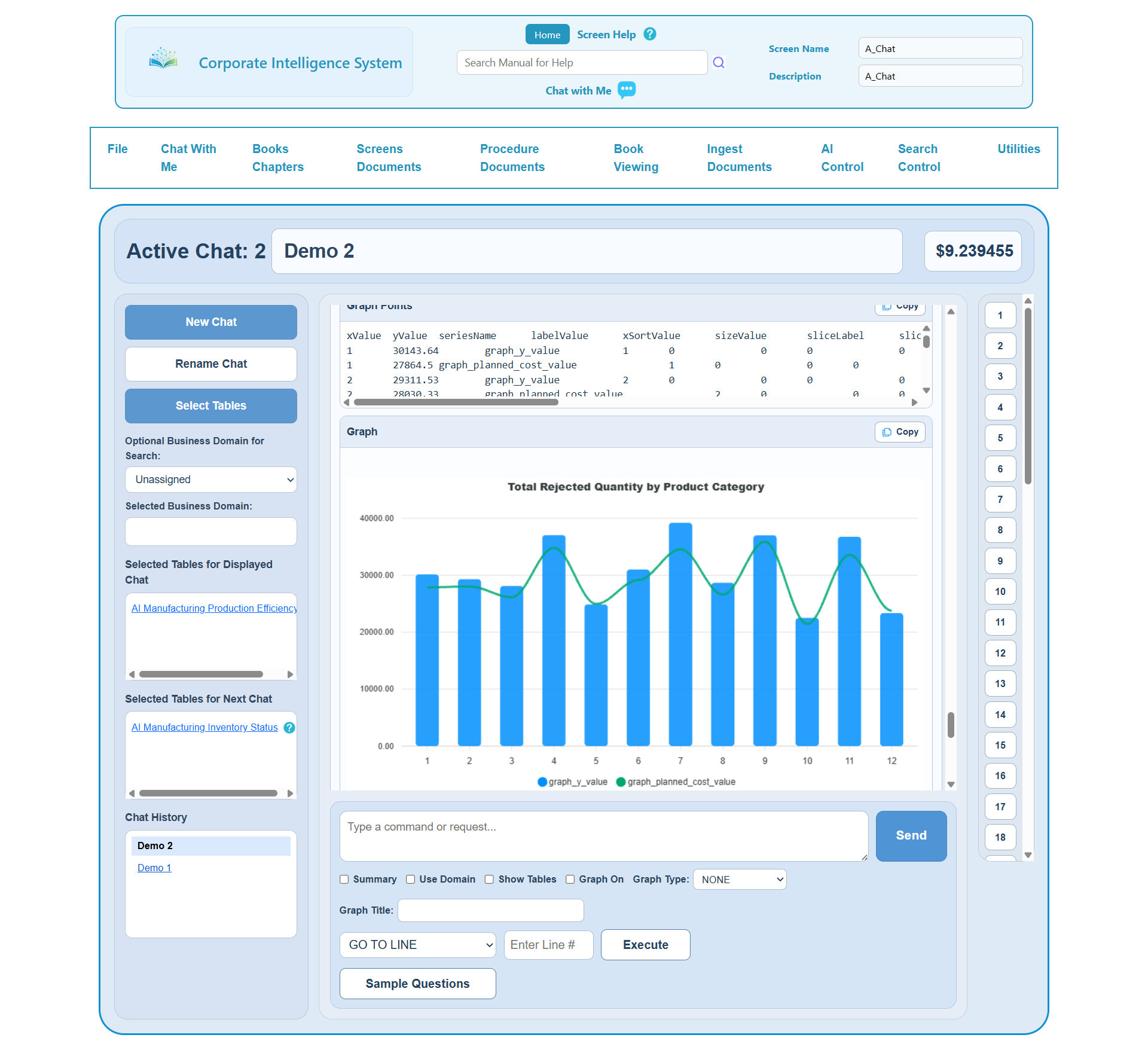
The Analytics Intelligence environment demonstrates how executives and business users can ask natural-language questions about current business operations. The platform generates the required SQL, retrieves authorized operational data, performs real-time analysis, creates executive visualizations, and presents the supporting graph data, retrieval plan, executed SQL, and evidence used to produce every conclusion.
How the platform works
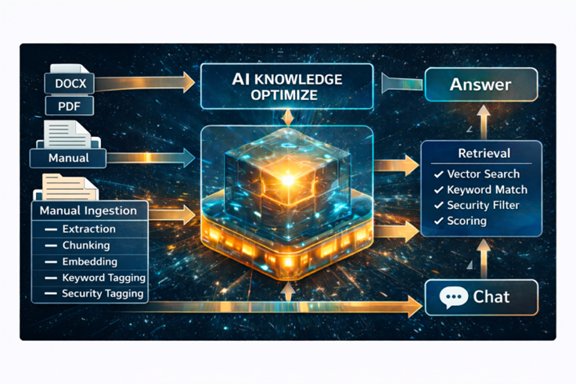
The system does not depend on a single retrieval method. It uses structured source identity, ingestion, keyword preparation, embeddings, scoring, filtering, and controlled response construction as coordinated layers.
From documents to answers
Documents, manuals, and procedures are transformed into structured content that can be indexed, embedded, searched, filtered, and assembled into answer context.
What you will gain from the book
- A clear understanding of why generic AI tools cannot reliably answer internal company questions.
- A system for converting existing documentation into a controlled knowledge platform.
- A practical retrieval architecture combining search, keywords, metadata, security, and embeddings.
- A framework for reducing dependency on support teams for routine information requests.
- A working companion platform that demonstrates the architecture in operation.